Creep Versus Fatigue: Comparing Time, Temperature, and Repeated Loading
This article was translated from its source language with AI assistance. Please check technical terms and equations against the original.
Key point: Creep concerns deformation that progresses with time under load; fatigue concerns damage associated with repeated loading. Equal elapsed times do not make test conditions identical. Compare temperature, load history, cycles, and dwell periods together.
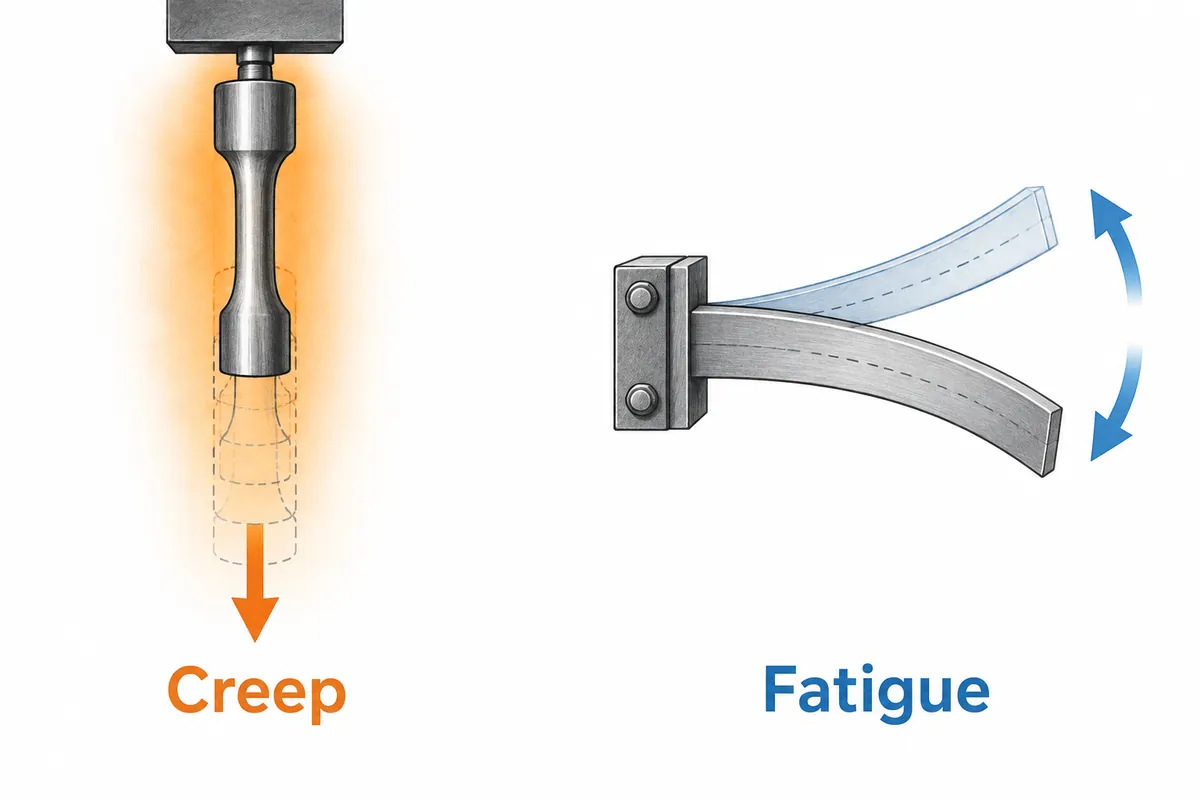
The process at a glance
This is an explanatory illustration, not an actual screen or task result.
1. Check material, processing history, geometry, and operating environment
2. Distinguish sustained and cyclic loading chronologically
3. Record temperature, stress, cycles, and dwell periods
4. Separate deformation, cracks, fracture, and nonfracture results
5. Assess comparable conditions and additional evidence needed
Does deformation continue over time, or does loading repeat?
A component loaded for a long period and one constantly vibrating under changing loads raise different questions. In creep, we examine whether deformation progresses with time while the load acts. In fatigue, we examine the relationship between repeated variable loading and damage, cracks, or fracture. Do not treat them as the same phenomenon merely because both can appear after time has passed.
This article explains basic metallic-material concepts and a sequence for comparing test and service records. It is not a report of testing a particular alloy or diagnosing an actual component's failure. The times and counts below are hypothetical conditions illustrating calculations. They cannot determine actual life, allowable stress, safe design, or standards compliance.
| Comparison question | When examining creep | When examining fatigue |
| Load history | How long was it maintained, and how did it change? | How do maximum and minimum loads repeat? |
| Progression axis | Relationship between elapsed time and deformation | Cycle count and damage or fracture results |
| Temperature | Actual temperature and its hold/change history | Temperature and environment during cycling |
| Additional records | Loading conditions and deformation measurement location | Frequency, waveform, mean and amplitude, and dwell periods |
| Result distinctions | Deformation, rate, and measurement interval | Cracking, fracture, interruption, and nonfracture status |
Time is an independent record in creep
MIT's structural-mechanics lectures describe creep as time-dependent and particularly important at high temperatures. This explains why values obtained immediately on loading should be recorded separately from those obtained during the subsequent hold. Do not omit conditions such as when timing began and whether initial deformation is included.
A statement that a load was maintained also needs evidence of its actual level and variation. Grouping a test with changing loads as though it had constant conditions changes its interpretation. Compare only after obtaining time-dependent records. Planning a long-duration test, or possessing one final number, does not establish creep characteristics.
One maximum load cannot represent fatigue conditions
Cambridge's structural-integrity teaching materials explain that fatigue life is affected by load-variation magnitude, pattern and frequency, defects, stress concentration, temperature, and environment. Thus, identical maximum stresses do not immediately make two tests equivalent. Record minimum stress, mean, amplitude, and waveform together to clarify what the repetition means.
The teaching materials' explanation that fatigue can occur even with maximum stress below yield strength is also an important distinction. Surviving one static test does not guarantee life in repeated service. Conversely, repeated loading alone does not establish that every observed failure was fatigue. Connect the actual history to evidence from failure analysis.
Temperature requires an actual history beyond “high” or “room” temperature
Do not prescribe one boundary temperature for every metal when explaining creep and temperature. Interpretation depends on material and conditions; record actual temperature, hold time, and measurement location. Evidence is also needed that room air and the loaded component have the same temperature. A displayed setpoint cannot replace a specimen's actual temperature record.
Temperature and environment also matter in fatigue comparisons. Do not fill missing temperature information with room temperature for convenience. The needed explanation changes depending on whether cycling began during heating, after temperature stabilized, or before conditions changed midway. Retaining an unknown field lets readers understand why comparisons must be limited.
The same 300 seconds can represent different load histories
If hypothetical test A performs 600 continuous cycles at 2 Hz, its cycling period is 600÷2=300 seconds. If hypothetical test B holds one load level for 300 seconds, elapsed times are numerically equal. But A has a cyclic history and B a hold history; matching times alone cannot establish equal deformation or life.
This calculation does not verify counts or times recorded by actual equipment. It is a simplified assumption excluding cycle start/end procedures and additional waits. Real records should separate preheating, loading, measurement start, cycling, and dwell periods. Also state that total test time can differ from the cycling period alone.
| Hypothetical condition | What arithmetic establishes | What the calculation does not establish |
| A: 2 Hz, 600 continuous cycles | Cycling period of 300 seconds | Fatigue life, crack size, or actual fracture |
| B: hold at one load level for 300 seconds | Hold period of 300 seconds | Creep deformation, rate, or actual damage |
| C: 2 Hz, 600 cycles followed by a 60-second pause | Sum of both periods: 360 seconds | Load and temperature during the pause |
| Compare A and B using time alone | The same number: 300 seconds | Identical load history or results |
| A test reaching its end without interruption | The programmed end point was reached | A guarantee against fracture in continued use |
Do not hide dwell periods behind a frequency calculation
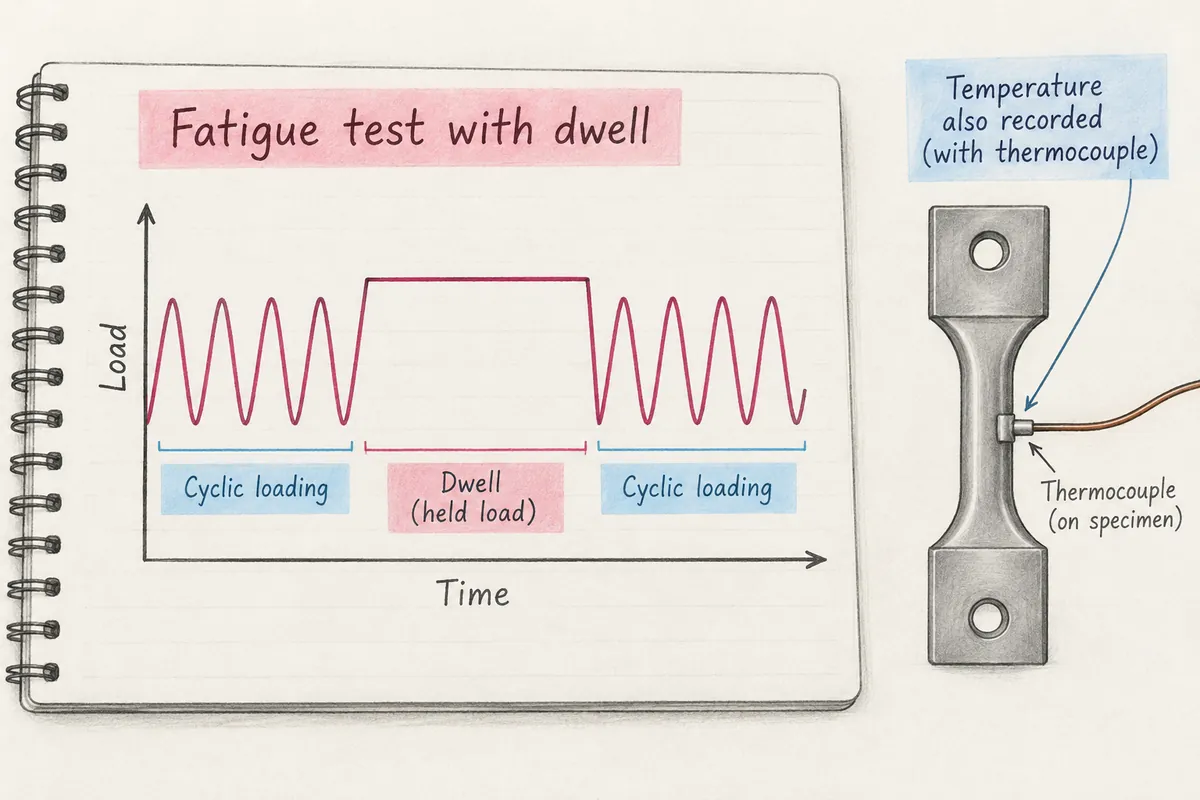
If hypothetical test C pauses for 60 seconds after the same cycling period as A, the illustrative two-period total is 360 seconds. “Pause” does not imply that load became zero. Record whether load was maintained, removed, or displacement fixed, together with temperature, to identify the history.
When high-temperature cycling includes hold periods, cycle count alone does not contain all necessary information. Rather than replacing this with the single label creep or fatigue, preserve each period and observations to define questions needing further assessment. This article does not numerically estimate interaction between the two effects or provide a design equation adding their damage.
Matching material names still require matching comparison conditions
Record alloy name and composition, processing and heat-treatment history, specimen orientation and surface condition, and geometry. Even materials sold under the same name require separate evidence that relevant conditions match. If specimen results differ from the actual component's geometry, stress concentration, or environment, state the applicability scope rather than simply transferring a life number.
For example, if two hypothetical specimens of the same alloy have different heat-treatment histories, their result difference cannot be attributed solely to loading type. A claim that microstructure caused it also requires microstructural evidence. This article does not infer structures or deformation mechanisms from processing history and present them as actual measurements.
Do not place deformation and rupture time in the same result field
Creep-related deformation at a particular time, strain rate calculated over an interval, and time to rupture are different quantities. Check the reported quantity's name and units. MIT's creep lectures also distinguish stress/time/temperature relationships and model applicability. Do not import an equation fitted to other conditions and claim it predicted actual results.
Calculating a rate requires the time interval and deformation data used. Drawing a curve first when measurements are absent can imply that real data exist. The illustration here shows a checking sequence, not a measured curve. For the same reason, do not impose typical stage names as observed facts in every test.
Record cracks, fracture, and no fracture as separate states
When a fatigue test ends at its planned count, first establish whether it ended in fracture or was stopped without fracture. Observing a crack also differs from fracture. Writing an unexamined crack as absent or recording the stopping count as fracture life changes subsequent comparisons. Retain the termination reason and confirmation method.
If a hypothetical record states only 600 cycles without a termination reason, the next question is what 600 means, rather than when fracture occurred. Establish whether it denotes the programmed count, actual completed count, or fracture count. A nonfracture result describes the checked interval; it does not establish safety under infinite repetition.
A single failure photograph cannot establish the mechanism
An external photograph can document failure location or deformation shape, but does not reveal the entire load history and material state. Actual cause analysis must also consider service records and necessary evidence such as surface and fracture-surface observations. Visible stripes in a photograph are not equivalent to confirming fatigue life under particular test conditions.
Other factors besides creep or fatigue may need investigation. Separating candidate causes, confirmed evidence, and still-needed material reduces premature labeling. This article did not inspect or analyze an actual failed component, nor does it generate photographs as genuine structural evidence. An explanatory comparison table is not a diagnosis.
Narrow the comparison when data are missing
If temperature or stress range is missing, first indicate whether sufficient conditions exist for numerical comparison. Do not fill gaps with representative values from other sources and declare identical tests. Seek exact histories and result definitions from authors or test personnel, or limit explanations to confirmed fields.
When units or cycle-counting conventions differ, retain the original notation and record conversion methods. Uncertain conditions can remain question marks or unverified. Distinguishing comparable and restricted aspects communicates useful conclusions better than adding arbitrary assumptions merely because the records are extensive.
Use the final comparison-table column for additional evidence needed
The final record should list material, processing and geometry; temperature and environment; chronological loading; cycling conditions; measurement method; result type; and termination status. Mark differing and missing fields before deciding which questions can be compared. For example, time conversion may be possible while life comparison is not.
Permission to use an actual component or its replacement timing must be determined through applicable standards and responsible assessment. The hypothetical 300 seconds and 600 cycles are not service recommendations. Distinguishing creep from fatigue requires a record linking load, time, temperature, and confirmed outcomes, rather than a single name.
Official sources and verification scope
- MIT OpenCourseWare — Time dependence and temperature in Structural Mechanics Unit 9
- MIT OpenCourseWare — Stress, time, temperature, and model scope in creep
- University of Cambridge — Structural integrity and fatigue-assessment conditions
Official documents checked: 2026-10-07. Recheck on publication: official teaching materials and actual material, composition, heat treatment, specimen, temperature, load history, and termination criteria. Do not use older teaching materials as current design standards or guarantees of an alloy's life.
AI writing assistance. The hypothetical examples, figures, and commands in this article are illustrative, not results of actual execution or testing. Check the environment and results when performing actual work.
Original illustrations created to help explain this article.
Original on Tistory ↗