Reading Nobel Chemistry Explanations: Separating Molecules, Reactions, and Applications
This article was translated from its source language with AI assistance. Please check technical terms and equations against the original.
Nobel Chemistry explanations sometimes discuss molecular structure, reactions, and technological applications in one paragraph. Separating what material was made, what it does, and how it is used in an actual device makes a long announcement easier to understand. In particular, “capturing a gas” and “converting it into another substance” require different questions.
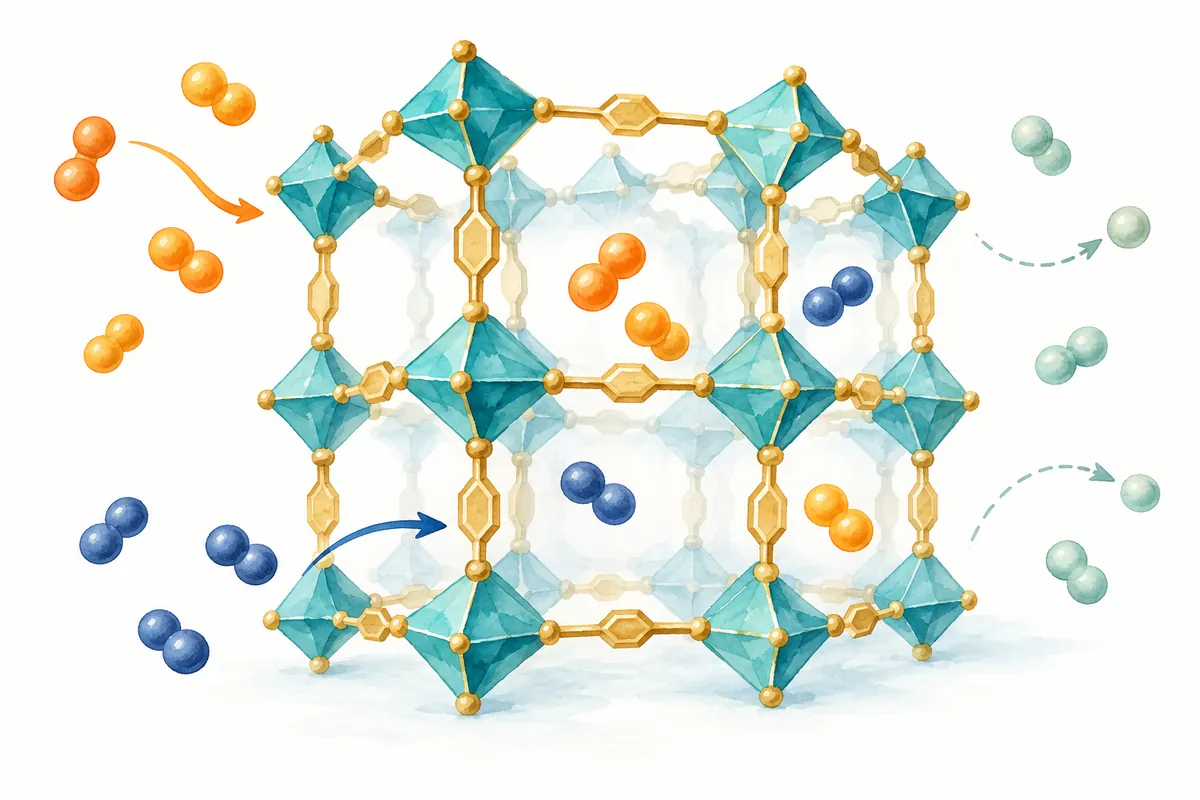
This article uses metal–organic frameworks from the already announced 2025 Chemistry Prize as a reading example. It does not preemptively state 2026 laureates or unverified announcements. Calculations and reading notes are illustrative, not results of synthesizing materials or measuring gas-capture performance.
Structure, function, and application in Chemistry Prize explanations at a glance
Explanatory illustration — not an actual screen or test result.
1. Check the year of the official announcement
2. Distinguish the components of molecules and structures
3. Separate capture and storage from chemical reactions
4. Check application test conditions and units
5. Record research findings and commercialization scope separately
1. Establish the year and award reason first
The Royal Swedish Academy of Sciences announced the 2025 Chemistry Prize for Susumu Kitagawa, Richard Robson, and Omar Yaghi for the development of metal–organic frameworks. The key reading points are that year and that research. Do not mix technologies from other years into the same award reason.
Try writing “2025, metal–organic frameworks, relationship between structure and function” on the first line of your reading notes. The award date, research period, and introduction of an application device can differ. Distinguishing this year's announcement from earlier research prevents imagining a Nobel Prize as a discovery made in one day.
For new information, read the actual official announcement for the relevant year. The material below explains reading 2025 sources, so it provides no basis for labeling its title or content as the 2026 prize outcome. Even if a new announcement exists at publication, past examples and new facts must retain their own sources and years.
2. Find component roles in structural explanations
The Academy explains that metal ions and organic molecules connect in MOFs to form crystal structures with large empty spaces. Distinguish the connection points, linking parts, and spaces resulting from their connection.
An analogy with a building's joints and beams can help explain the structure. But the real material is not a building with visible rooms, and the analogy does not precisely reproduce an atomic arrangement. Its role is explaining relationships; actual size and structure require information on the specific material.
| Level of explanation | Question to ask | Starting point in the MOF example |
| Composition | What is it made of? | Metal and organic linking components |
| Structure | How are they connected? | A crystal structure containing voids |
| Function | What does it interact with, and how? | Capturing particular substances, for example |
| Application | For which device or purpose is it used? | Questions about separation, storage, and water collection |
The mention of organic molecules does not mean that the entire MOF is simply one ordinary small molecule. The announcement describes a crystalline material with connected components. Distinguishing whether a sentence concerns a component or the whole material also clarifies what “changing molecules” refers to.
3. Separate capture, storage, and release from reaction
UC Berkeley explains gas attachment to extensive internal surfaces and adjusting metal and organic components to select gases for capture. If the process described is entering, attaching, and leaving the material, do not automatically equate it with a reaction producing a new substance.
When reading “captures carbon dioxide,” ask what is collected and from where. That sentence alone does not imply that all carbon dioxide decomposes and disappears. If a reaction is described, separately establish which reactants become which products and the evidence supporting it.
The Academy's announcement mentions applications assisting chemical reactions alongside capture and storage. Multiple applications in one source do not mean one material performs every function under identical conditions. Turning each verb into a function-specific question helps compare distinct performances.
4. Identify what is captured and what is excluded
“Capture” needs a target substance. Check which gas is collected, whether it is mixed with other substances, and whether the goal is separation or storage. A general statement that it “holds much gas” cannot establish identical performance for every gas.
Berkeley explains adjusting metals and organic links to capture particular molecules while excluding others. The resulting question is “which material composition worked in which mixture?” If names of differently composed materials are missing, find the target of the performance claim again.

A hypothetical paper note might read “material A, target gas X, accompanying gas Y, observation conditions.” This is an information-separation template, not a chemical formula from real MOF research. Filling X with an actual substance requires checking its name and conditions in the original.
5. Attach denominators and conditions to performance figures
Suppose 1 g of illustrative hypothetical material captures 20 mg of gas under specified conditions. The mass-based ratio is 20 mg/g. Another hypothetical case with 2 g of material capturing 40 mg also calculates to 20 mg/g. These figures illustrate units, not actual MOF performance or guaranteed values.
| Hypothetical data | Calculation | Ratio |
| Material 1 g, gas 20 mg | 20 ÷ 1 | 20mg/g |
| Material 2 g, gas 40 mg | 40 ÷ 2 | 20mg/g |
| Additional information needed for comparison | Material type, gas, temperature, pressure, and measurement basis | |
Even matching ratios do not establish equal performance if gases, temperatures, pressures, or measurement bases differ. Unit conversion is only one part of condition comparison. Also distinguish figures whose denominator is the entire device mass rather than material mass.
Multiplying a small material sample's ratio directly by a large device size is not a measurement of actual device performance. State additional assumptions and check whether actual device data exist. Turning an impressive surface-area analogy from an official explanation into hourly output or cost also needs separate evidence.
6. Read the connection between laboratory function and application devices
A material's ability to collect a substance and the existence of a usable device are different stages. In device descriptions, read where the material goes, the inputs and outputs, and operating conditions. An article mentioning only potential applications does not establish actual device testing.
For a hypothetical water-collection device, ask “How is water collected from air recovered, and under which conditions and over what period was the quantity reported?” These are questions for finding needed information, not an evaluation of a specific product. Find conditions in the original for any unqualified number.
Read commercialization, prototype, and research potential as distinct terms. Demonstrating a function in research does not establish economical use in every region. For costs or repeated-use life, separately check whether actual sources address those subjects.
7. Criteria for tabulating multiple applications
If a paragraph mentions water collection, carbon capture, and reaction applications, make a separate row for each. Record its target substance, function, and evidence. Combining them into “a material solving every environmental problem” erases individual conditions.
A hypothetical reading table can describe water collection as collecting moisture from air, carbon capture as separating and storing carbon dioxide, and reaction applications as assisting a particular reaction. Actual materials and performance require originals for each application. Do not fill empty fields with figures from a different application.
If one source explains the award reason and another structure and function, attach the appropriate link to each claim. Having two sources does not mean every performance detail was independently established in both. Retain evidence only for what was actually read.
8. Distinguish explanatory illustrations from structural photographs
The illustrations here compare reading categories: components, connected structure, function, and application. They are neither modified institutional diagrams nor reproductions of a specific MOF's actual crystal structure. A conceptual illustration should not use wording suggesting a real photograph or measured data.
For actual structural images, read captions and legends to identify their meaning. A component model and experimentally obtained imagery are different materials. Attractive colors do not establish the actual material's appearance or property values.
9. Checklist for explaining an announcement in your own words
Try organizing the explanation around “which year and research, what was made, what structure it has, what it does to which substances, what applications are presented, and which performance remains unverified.” Focus on the structure and function being read instead of extensively listing laureate backgrounds.
Finally check that capture was not turned into reaction, different materials were not merged into one, and numerical units and conditions remain. These questions preserve the excitement of Nobel news while distinguishing what the reader understood from what still needs investigation.
Official sources and writing standards
- Royal Swedish Academy of Sciences: The Nobel Prize in Chemistry 2025
- UC Berkeley: Omar Yaghi shares 2025 Nobel Prize in Chemistry
References checked: 2026-10-07. This explanation was written with AI assistance based on official sources actually opened. Separately marked calculations, code, and checking examples are illustrative, not results from directly testing or measuring the user environment. Recheck changes to features and references on the publication date.
Original illustrations created to help explain this article.
Original on Tistory ↗